Taking Over Europe
The economic incentives and administrative structures driving the relentless replacement of local tennis courts with glass cages.
The Real Estate Equation
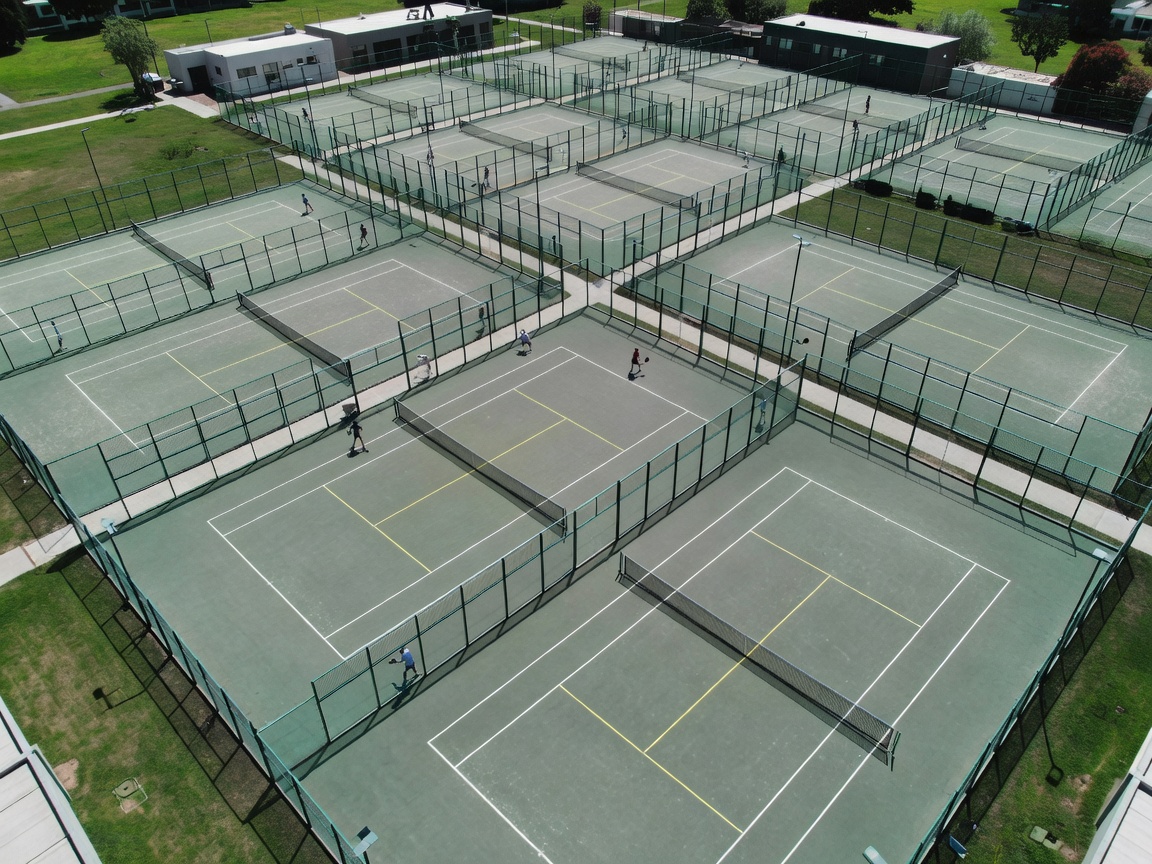
The spread of padel across Europe is less a sporting phenomenon than a matter of brute commercial arithmetic. A standard tennis court occupies approximately 650 square metres of valuable club real estate, accommodating a maximum of four players. In that exact same footprint, a club can install three padel courts, accommodating twelve players simultaneously.
Because padel matches are shorter and more social, turnover is higher. A club manager looking at a severely underutilized, cracking macadam tennis court sees an obvious solution. The initial capital expenditure for the concrete ring beams and glass enclosures is rapidly offset by tripling the hourly court fees. This basic geometric truth is driving the physical restructuring of racket facilities from Stockholm to London.
Administrative Integration
Unlike sports that develop in a vacuum, padel’s expansion in many markets has been absorbed by existing tennis federations. In the United Kingdom, the Lawn Tennis Association (LTA) formally brought padel under its administrative umbrella, providing the necessary institutional weight to secure planning permissions and funding grants for new courts.
This integration is highly strategic. Tennis federations have struggled with declining participation and aging demographics. Padel offers an immediate injection of young, affluent players into the club ecosystem. By co-opting the sport rather than fighting it, traditional governing bodies ensure their continued relevance in the racket sports market.
The Premier Padel Tour
At the elite level, the sport underwent a dramatic restructuring. For years, professional padel was a relatively closed circuit, dominated entirely by Spanish and Argentine athletes playing primarily in their home countries. The intervention of sovereign wealth funding led to the creation of the Premier Padel circuit, sanctioned directly by the International Padel Federation (FIP).
This new tour rapidly consumed the older, privately owned circuits, injecting massive prize money and securing global broadcast deals. By staging tournaments in iconic venues globally—ranging from Roland Garros in Paris to purpose-built arenas in the Middle East—the tour transformed padel into a highly polished television product.
Demographic Penetration
The core appeal driving this expansion is the sport's shallow learning curve. Tennis requires months of frustrating technical instruction before a beginner can sustain a ten-shot rally. The long rackets and high-tension strings demand precision. Padel, by contrast, hands a beginner a short, solid paddle and surrounds them with walls that forgive over-hit shots.
Two absolute novices can enjoy a competitive, physically exhausting hour on a padel court on their very first attempt. This rapid acquisition of competence results in extraordinarily high retention rates. The sport is particularly adept at capturing former athletes from other disciplines whose knees no longer tolerate the explosive sprinting required by squash or singles tennis.
The Olympic Ambition
The stated, overriding goal of the International Padel Federation is inclusion in the Olympic Games. The criteria for Olympic status are stringent, requiring a sport to be played widely across dozens of countries on multiple continents. Until the 2010s, padel could not meet this threshold, remaining functionally confined to the Hispanic world.
The aggressive, continent-wide court building boom is the necessary prerequisite for meeting these IOC requirements. By deliberately pushing the sport into Northern Europe, Asia, and North America, the governing bodies are constructing the necessary statistical footprint to present padel not as a regional curiosity, but as an undeniable global standard.
The Industrial Pipeline
Supporting this expansion is a massive, rapidly scaled industrial pipeline. Factories that once produced generic composite materials are now dedicated to churning out millions of EVA-core palas. Architectural firms specialize entirely in the zoning and acoustic modeling of padel enclosures. What began as a Mexican backyard compromise is now a multi-billion euro infrastructure project.