Geometry and Glass
The rigid specifications of the 10 by 20 metre cage, and how a transparent boundary shapes every tactical decision inside it.
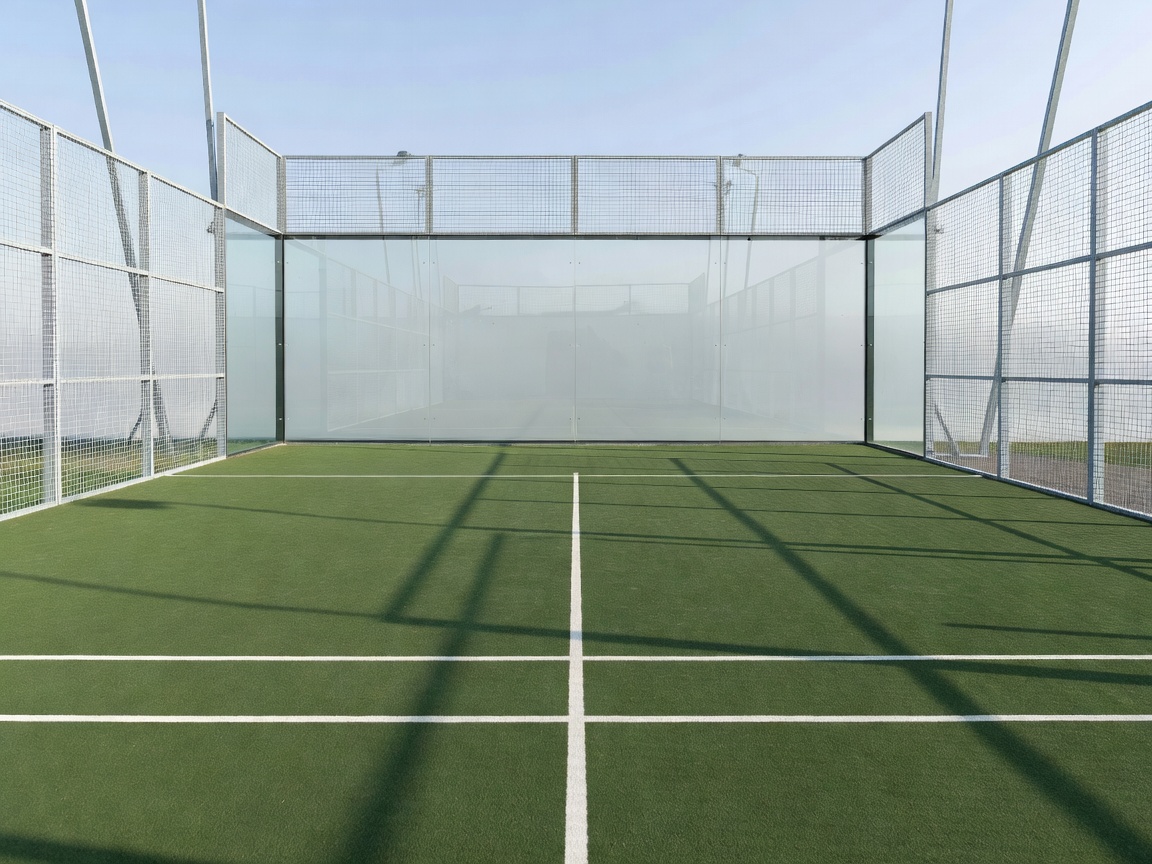
The 10 by 20 Confinement
A padel court is a study in strict limitation. The playing area measures exactly 10 metres wide by 20 metres long, roughly one-third the size of a standard tennis court. This reduced footprint is the engine of the sport. Because the space is cramped, power is usually counterproductive; hit the ball too hard, and it simply rebounds off the back wall directly into the opponent's strike zone.
The space is bisected by a net, with service lines drawn 6.95 metres back. Every rally is an attempt to occupy the net position, pushing the opposition back against the glass. The geometry demands lateral movement and vertical anticipation rather than the deep baseline sprinting seen in traditional racket sports.
Glass versus Concrete
Historically, the solid walls enclosing the back and corners of the court were fashioned from masonry or concrete. The modern standard, however, is tempered glass, usually 10 to 12 millimetres thick. The shift to glass was driven entirely by the spectator experience; concrete blocks make for terrible television.
For the player, the glass acts as an unpredictable ally. The ball rebounds with a clean, predictable trajectory off a flat glass pane, provided it does not hit a structural joint. The glass walls stand 3 metres high at the back, meaning a defensively skilled player can salvage a point from what would be a decisive winner on an open court.
The Wire Mesh Grid
While the back walls and corners are glass, the upper sections and the central sides of the court are enclosed in wire mesh. The rules stipulate the mesh must be high enough to prevent easy escapes—reaching 4 metres in total height at the back.
The mesh is tactically treacherous. While the glass offers a true bounce, the wire mesh absorbs pace and ejects the ball at random angles. A shot driven into the side mesh is often unplayable. Thus, aiming for the wire is a deliberate attacking strategy, turning the enclosure’s structural variations into a weapon.
The Synthetic Surface
Padel is not played on hardcourts. The mandatory surface is artificial turf, heavily dressed with fine silica sand. The sand serves two purposes: it weighs down the synthetic fibres to provide a uniform playing speed, and it permits players to slide into their shots.
Recent developments have seen a move toward "monofilament" curly turf with less visible sand, favored by professional circuits because it looks better on broadcast cameras. Regardless of the exact fibre composition, the surface is inherently slow. The ball sits up, further nullifying sheer power and forcing players to rely on placement and spin.
Net Mechanics and Exits
The net stretches 10 metres across the centre, standing 0.88 metres high in the middle and slightly higher at the posts. Uniquely, the court includes specific exit doors flanking the net on either side. These openings are not merely for players to enter; they are actively in play.
If a smash bounces high and leaves the court over the 3-metre side wall, a defending player may legally run out through the door and attempt to hit the ball back over the enclosure before it strikes the ground. It is a rare, athletic spectacle that relies heavily on clear paths and a lack of stray equipment outside the cage.
Structural Practicalities
The proliferation of padel has exposed the engineering hurdles of court installation. A court weighs several tons once the glass, steel pillars, and sand are accounted for. Converting a tennis court into three padel courts—the standard economic ratio—requires pouring concrete ring beams to support the heavy glass panels.
Furthermore, indoor facilities must contend with ceiling heights. A proper lob is the foundational shot of the sport, and a warehouse with a ceiling lower than 7 or 8 metres fundamentally alters the game, removing the defensive high ball and transforming padel into a claustrophobic slugfest.