The Pala and the Ball
How strings were replaced by perforated foam cores, creating a highly lucrative market for rapidly degrading composite materials.
The Stringless Implement
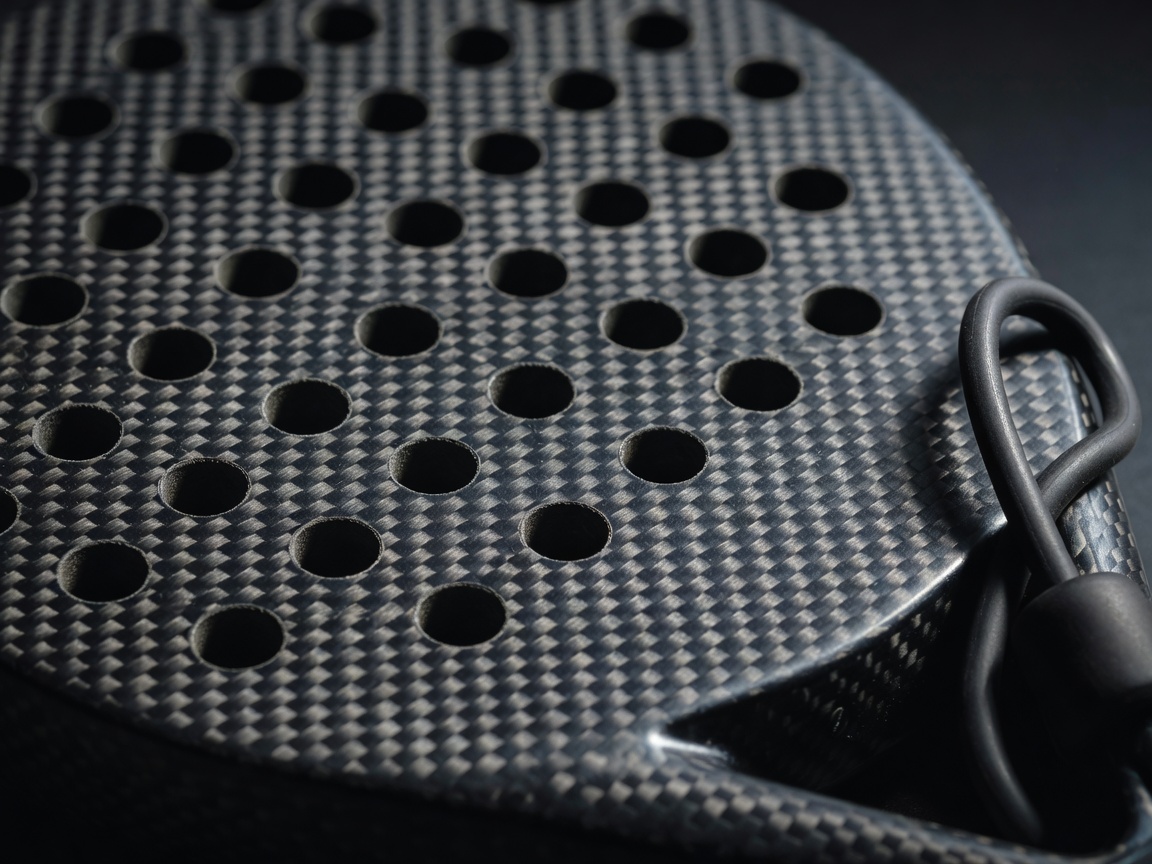
The most immediate distinction of padel lies in the hand of the player. There are no strings. The padel racket, invariably referred to by its Spanish name, the pala, is a solid slab of composite material, interrupted only by a mandated pattern of holes to reduce air resistance. The regulations dictate a maximum size, ensuring the implement remains compact and maneuverable close to the body, a necessity when defending balls off the body or the glass.
Because there are no strings to break and restring, a pala is a consumable item that slowly loses its structural integrity. The foam core degrades with every impact. A competitive player does not maintain a pala; they merely extract its useful life before discarding it.
Rubber Cores and Carbon Faces
The core of a pala is typically constructed from either EVA rubber or a softer polyethylene foam. The density of this core dictates the racket's behavior. A softer core provides a trampoline effect, assisting beginners by generating pace with minimal effort, while a dense EVA core requires the player to supply the power but offers precise control in return.
This core is sandwiched between layers of exterior material, usually fibreglass for entry-level models and carbon fibre for advanced variants. The carbon fibre provides stiffness, ensuring that when the ball is struck cleanly, the energy transfer is immediate rather than absorbed by the racket face.
Shape and Balance
Manufacturers produce palas in three distinct shapes, entirely dictating the racket's balance and the location of its sweet spot. A round racket features a low balance point and a large central sweet spot, favored by defensive players who prize control. Diamond-shaped palas push the weight toward the top edge, generating vicious leverage for smashes but severely punishing off-centre strikes. The teardrop shape attempts an uneasy compromise between the two.
The Depressurized Ball
To the untrained eye, a padel ball is a tennis ball. It is yellow, spherical, and covered in felt. However, the internal pressure is marginally lower. This depressurization is deliberate. A standard tennis ball played inside a 10-metre glass cage would ricochet with uncontrollable velocity, reducing rallies to chaotic, violent brevity.
The padel ball sits lower and bounces with less enthusiasm. It demands that players aggressively bend their knees to dig the ball out of the corners. The slightly smaller size and reduced pressure ensure the game remains tactical, frustrating the player who relies solely on baseline pace.
Footwear Imperatives
Running shoes on a padel court are a hazard. The artificial turf, dressed with silica sand, behaves much like a clay tennis court. Consequently, padel footwear requires specific sole patterns—usually a deep herringbone tread—to grip the synthetic fibres while allowing for controlled slides into defensive positions.
The shoes must also endure extreme lateral stress. Because the court is small and the net exchanges are rapid, players spend most of their time moving side-to-side and pivoting abruptly. The reinforced uppers of a padel shoe are designed to prevent the foot from rolling over the sole during these harsh lateral stops.
The Equipment Economy
The equipment represents a lucrative ecosystem. A high-end carbon fibre pala commands a significant premium, yet its lifespan is finite. Unlike a tennis racket frame, which can survive a decade with regular restringing, a pala subjected to daily professional use will soften and die within weeks. The amateur market is therefore sustained by a constant cycle of replacing degraded foam cores, a structural reality that equipment manufacturers have no incentive to solve.